Start your HVACRU Mentorship today!

Capacitors: Sorting Fact from Fiction
The myths about capacitors.
HVAC
Justin Burns
3/23/20264 min read
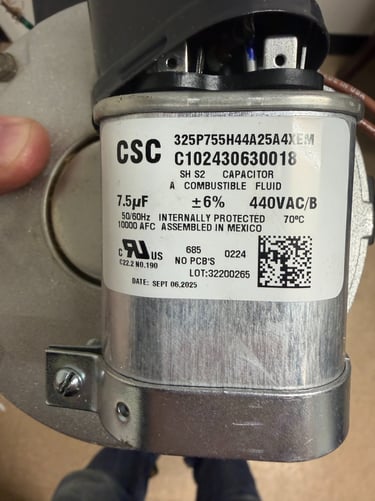
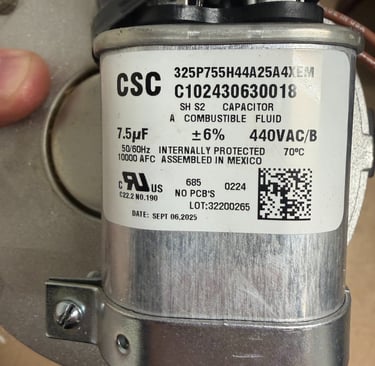
If you're new to the HVAC trade, you've probably heard a lot about capacitors. Maybe someone told you they "boost voltage" or that "current flows through them." I remember hearing the same things early on, and it took me a while to sort out the truth from the myths. So let's set the record straight.
What is a Capacitor, Really?
A capacitor is basically two metal plates separated by an insulating material. When voltage is applied, one plate builds up a positive charge and the other builds up a negative charge. That stored energy is what helps your single-phase motors start up and run efficiently. That's it. No magic voltage boosting happening.
Busting the "Voltage Boost" Myth
So where does the "voltage boost" myth come from? When you measure voltage across a running capacitor, you'll sometimes see a reading higher than the supply voltage. That's not the capacitor creating extra voltage — it's back-EMF (electromotive force) from the motor. The motor's spinning creates its own voltage that adds to what the capacitor is putting out. The capacitor is just doing its job storing and releasing charge in rhythm with the AC cycle.
Does Current Flow "Through" It?
Here's another one that trips people up: "current flows through a capacitor." Technically, current never passes through the insulating material between those plates. What actually happens is current flows to the capacitor, charges it up, and then the capacitor discharges. In an AC circuit, this charge-discharge cycle happens so fast (60 times a second) that it looks like current is flowing straight through. But it's not.
Why This Matters on the Job
Why does any of this matter on the job? Because capacitors are one of the most common failure points on single-phase equipment — which is most of what you'll see in residential work. When a capacitor fails, the motor it supports either won't start, runs sluggish, or draws excessive amperage. If you don't understand what a capacitor actually does, you might misdiagnose the problem or replace parts that don't need replacing.
Start vs. Run Capacitors
There are two main types you'll encounter: start capacitors and run capacitors. Start capacitors give the motor a big burst of energy to get the rotor spinning. They're only in the circuit for a second or two during startup, and they're usually removed by a potential relay or start relay. Run capacitors stay in the circuit the whole time the motor is running. They help maintain the phase shift that keeps the motor efficient.
Start Capacitors: These give the motor a massive "kick" of energy to get the rotor moving. They’re only in the circuit for a second or two before a potential relay or start relay pulls them out.
Run Capacitors: These stay in the circuit the whole time the motor is running to maintain the phase shift that keeps the motor efficient.
The "Dual Run" Confusion
You'll also see dual run capacitors, which are really just two run capacitors in one package. They have three terminals: C (common), FAN, and HERM (hermetic, meaning compressor). The C terminal feeds both the fan and compressor run circuits. Here's where it gets confusing — the C on a capacitor and the C on a compressor are not the same thing. On a compressor, C is the common point between the run and start windings. On the capacitor, C is the common power feed. Mixing these up is one of the most common wiring mistakes apprentices make.
C (Common): This is the power feed from the contactor.
FAN: Goes to the condenser fan motor.
HERM: Short for "hermetic," which goes to your compressor start wire.
Testing and Maintenance
When you're testing capacitors, you'll want a meter that can measure microfarads. Pull the capacitor out of the circuit, discharge it safely (short the terminals with an insulated screwdriver), and measure. Compare your reading to what's printed on the capacitor. Most manufacturers say plus or minus 6% is acceptable, but I'd start thinking about replacement if you're more than 5% off. A weak capacitor might still let the motor run, but it's working harder than it should.
A few practical tips for your tool bag. First, always discharge a capacitor before handling it — even a "dead" one might have enough stored charge to give you a nasty jolt. Second, when replacing a dual run cap, double-check your wiring. The HERM terminal goes to the compressor start wire, FAN goes to the condenser fan motor, and C gets the power feed from the contactor. Third, never use a start capacitor as a run capacitor or vice versa. They're built differently for different jobs.
One more thing that'll help you in the field: learn to recognize a bad capacitor by sight. A bulging top or bottom of the capacitor casing is a dead giveaway that it's failed. Sometimes they'll actually rupture and leak brown oil. If you see signs of leaking or physical deformation, that capacitor is definitely coming out. Even if it's technically still measuring within specs, a visibly damaged capacitor is unreliable and should be replaced. Trust your eyes on this one.
Wrap Up
Capacitors might seem like simple little components, but understanding how they actually work puts you miles ahead when you're standing in front of a unit that won't start on a hot afternoon. Learn the fundamentals now and you'll thank yourself later.
Keep learning and stay safe out there.
-JB
Contact
Questions? Reach out anytime.
hello@hvacru.com
© 2026. All rights reserved.