Start your HVACRU Mentorship today!

Making Sense of 3-Phase Motors
A primer on 3-phase motors.
HVAC
Justin Burns
3/30/20263 min read
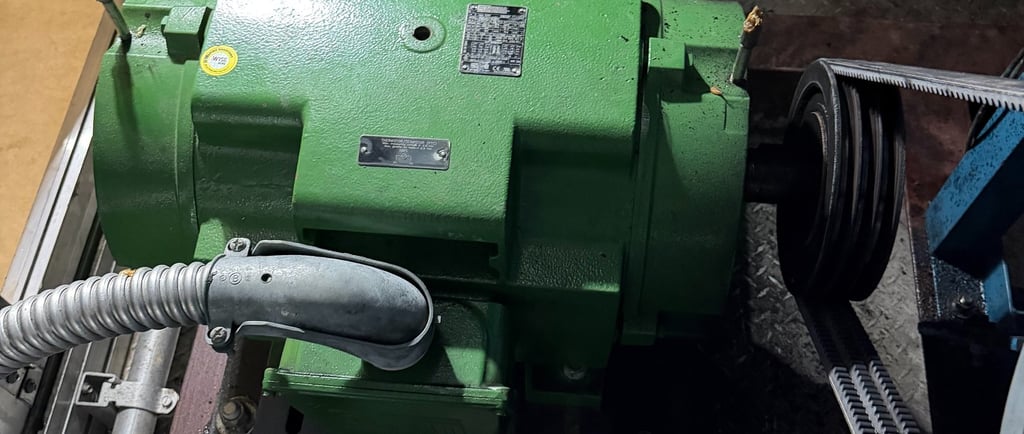
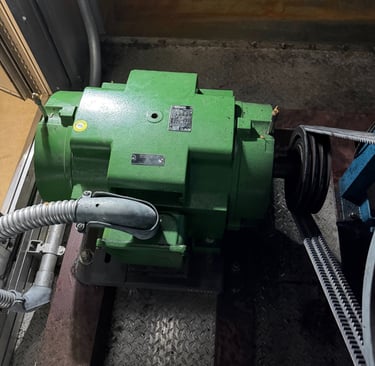
Introduction: Moving from Residential to Commercial HVAC
If you've been working residential HVAC, most of what you've seen is single-phase equipment. But as you move into commercial work or start handling bigger systems, 3-phase motors are going to become part of your everyday life. Let's break down the basics so you're not caught off guard.
The Mechanics of Single-Phase Power
In a single-phase system, you have one alternating current waveform — it goes positive, crosses zero, goes negative, and repeats 60 times per second. That's your 60 Hz frequency. The problem with single-phase for larger motors is that there's a moment during each cycle where the voltage crosses zero and the motor gets no push. That's why single-phase motors need capacitors and starting mechanisms — to get them through those dead spots.
How Three-Phase Power Works & Its Advantages
Three-phase power solves this elegantly. The utility generates three separate AC waveforms, each offset by 120 degrees from the others. At any given instant, at least one phase is near peak voltage. This means a 3-phase motor gets a continuous, smooth push without any dead spots. No start capacitor needed, no start relay, no potential relay. The motor just spins.
That simplicity is one of the biggest advantages of 3-phase motors. Fewer components means fewer failure points. No capacitors to go bad, no start relays to fail. The motor itself is more efficient and produces more torque for its size compared to a single-phase equivalent.
When you're working with a 3-phase motor, there are a few key things to get right. First is voltage: the motor nameplate tells you what voltage it needs — typically 208V, 230V, or 460V. You need to verify that the supply voltage matches. Running a 208V motor on 240V or vice versa causes efficiency loss and excess heat.
Second is rotation. Three-phase motors have a definite direction of rotation determined by the phase sequence. If your motor is spinning backwards (compressor won't build pressure, fan blowing the wrong way), you swap any two of the three phase leads and the motor reverses. This is something you'll never have to worry about with single-phase, but it's critical with 3-phase.
Third is motor sizing. Here's a handy rule: you can use a physically larger motor than the original if the mounting fits, as long as you properly size the conductors and overload protection for the larger motor's amperage. You can't just drop in a bigger motor and keep the same wiring. But having the flexibility to go larger can save you in situations where the exact replacement isn't available.
Understanding Overload Protection
Overload protection on 3-phase motors works differently too. Some motors have internal overloads built into the windings. Others rely on external overload relays, often mounted in a motor starter or variable frequency drive. Understanding which protection scheme your motor uses is essential for troubleshooting. If the motor won't run, you need to know where to check for a tripped overload.
Troubleshooting: The Danger of "Single-Phasing"
When you're troubleshooting a 3-phase motor that won't start, check all three legs of power. A single blown fuse or open phase will prevent the motor from starting, or worse, it'll try to run on two phases (called single-phasing) and burn up quickly. Use your meter to verify voltage on all three legs at the motor terminals while the motor is trying to start.
Identifying and Measuring Phase Imbalance
Phase imbalance is another concern. If the three phases aren't delivering approximately equal voltage, the motor runs inefficiently and generates excess heat. A voltage imbalance of more than 2% can reduce motor life significantly. Check and document all three phase-to-phase voltages: L1-L2, L2-L3, and L1-L3. They should all be within a few volts of each other.
Performance and Reliability in the Field
On your first commercial jobs, you'll probably notice that compressor speeds seem different between 3-phase systems and the single-phase equipment you've been working on. That's because 3-phase motors are more efficient and produce more consistent torque throughout the rotation cycle. This means higher cooling capacity for the same physical size, and less reliance on capacitors and starting mechanisms. It's one reason commercial equipment is generally more reliable — the motors are inherently simpler and more forgiving.
Three-phase motors are honestly simpler than single-phase once you understand the fundamentals. Fewer moving parts, more reliable operation, and straightforward troubleshooting. Get comfortable with them now and you'll be well-prepared for the commercial side of this trade.
Keep learning and stay safe out there.
-JB
Contact
Questions? Reach out anytime.
hello@hvacru.com
© 2026. All rights reserved.